
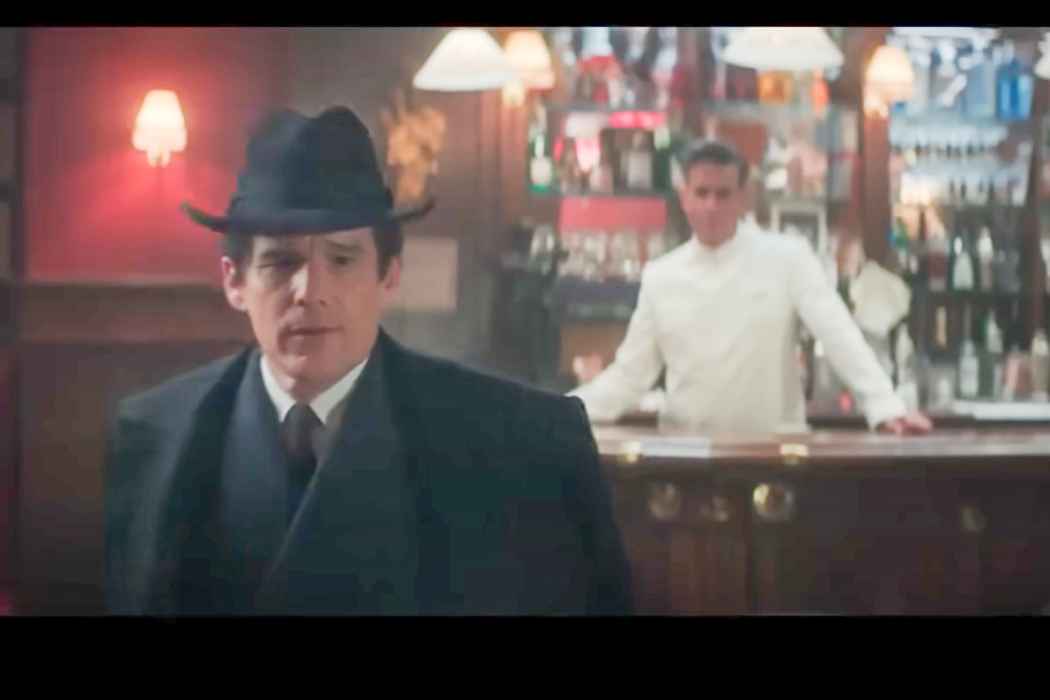
(Photo Credits: Screengrab from Sony Pictures Classics’ Official YouTube Account)
In Blue Moon (2025), director Richard Linklater offers an intimate portrait of lyricist Lorenz Hart, centering on one long, emotionally fraught evening in 1943. The film unfolds largely in Sardi’s, the legendary theater-district bar in New York, where Hart, reeling from self-doubt and drinking, retreats after the opening night of Oklahoma! Hart — played by Ethan Hawke — grapples with the specter of his former creative partner Richard Rodgers, portrayed by Andrew Scott, as he attempts to process his fears of obsolescence, loneliness, and internal torment.
The supporting cast enriches the night’s tension: Margaret Qualley appears as Elizabeth Weiland, a confidante in Hart’s emotional circle, while Bobby Cannavale plays Eddie, a bartender figure who listens to Hart’s confessions and confrontations. Other players drift through the bar’s smoky corridors, memory, hallucination, and regret all bleeding together. Behind the scenes, Shane F. Kelly’s cinematography bathes the interior in deep shadows and atmospheric lighting, while Sandra Adair’s editing stitches together Hart’s unraveling internal monologue. The score by Graham Reynolds underscores grief and longing with minimalist piano and string motifs.
Blue Moon made its debut at the Berlin International Film Festival on February 18, 2025, where Andrew Scott was awarded the Silver Bear for Best Supporting Performance. In the U.S., it is slated for a limited release beginning October 17, before expanding nationwide October 24. As of now, there is no confirmed streaming release or Netflix availability, so fans hoping for a digital option will need to wait for further announcements.
Early critical reception has been mixed but respectful. Many reviewers praise Hawke’s performance as affecting — a tortured artist who roams through memory and regret with fragile power. Scott’s portrayal has garnered acclaim for giving Rodgers both warmth and distance, offering a quietly stern counterpart. The bar setting, combined with real-time drama, is seen by some critics as both the film’s strength and its limitation: the claustrophobic stage allows emotional density but sometimes slows momentum. A few note that while the screenplay — adapted from Robert Kaplow’s work — is elegantly written, it leans heavily on mood and monologue over narrative propulsion.
Ultimately, Blue Moon stands out as a character study more than a sweeping biopic. It’s a night of confrontation with one’s own ghosts, a conversation in darkness, fraught but tender.
Happy viewing!





Ethan Hawke, I tend to watch anything he’s in as I really love his craft. This movie seems like it’s a bit cerebral, which I love, sick of streaming nothing but stylized senseless violence/ or guts and gore. Not to mention, there’s always been some sexy about him.
NOT in the PREVIEW there SURE ISN’T!!!! 🙁 They DEF HIT him with the FUGLY UGLY stick in THIS MOVIE!!!! 🙁 LOLOLOLOLOLOLOL
K, but you know what, I gonna watch, draw my own conclusions, thanks.
smoky corridors
memory
hallucination
regret
deep shadows
unraveling internal monologue
claustrophobic
Supporters claim Gays suffer from depression, mental, illness and anxieties more than the general population. Let’s keep that up by immersing ourselves into movies like this!
Falling In Love With Love/Is Falling For Make Believe/Falling In Love With Love/Is Playing The Fool/Caring To Much/Is Such A Juvenile Fancy/Learning To Trust/Is Just For Children In School…
Let’s NOT!!!! The STR8’s have ALL the MENTAL illness, depression, anxiety, COMPULSIONS and OBSESSIONS that the LGBTQ+ community have so WHO gives a FLYING FK what they SAY about US!!!!!!!!!! HELLA not me!!!
And the Acceptance Train slows.
WHO CARES about ACCEPTANCE dude!!! What are you RUNNING FOR – CLASS PRESIDENT?!!?!? Get a friggin’ LIFE!!!!!!!! and PUT ON your BIG GURL panties while you’re AT IT!!!! Are THEY paying YOUR BILLS $$$$$$$$$??????? LOLOLOLOLOL
From the A4A Community Guidelines pages:
“This is your community and we encourage you to interact with each other respectfully, peacefully and thoughtfully and in accordance with the law.“
Which LAWS have I BROKEN by not GROVELING for ACCEPTANCE from the GENERAL PUBLIC?!?!!? The ONLY acceptance I NEED is my OWN and I gave that to myself LONG LONG ago – and FREED myself from CARING what ANYONE ELSE thinks about me!!!! Maybe you should TRY that ONCE in your life, dude!!!!!!!!!!
“…respectfully, peacefully…”
Oh Whatever!!!!
“whatever”
Some people say “fuck you” then, but that reflects worse on themselves than the person they flung it at.
Maybe we can just work on being respectful, eh?
Sure – and I DEF respect OTHER OUT and PROUD LGBTQ+ brothers and sisters that LIVE their TRUTH no matter WHAT the general public think!!!!