(Photo Credits: Orator, CC BY-SA 4.0, via Wikimedia Commons)
A 21-year-old man identified by authorities as Abdul Ballout was shot and killed by police in Berlin on Sunday, July 26, after allegedly carrying out a deadly attack near the city’s Christopher Street Day (CSD) Pride celebrations the previous night.
The attack happened at around 10 p.m. on Saturday, July 25, in Berlin’s Tiergarten park, close to the Brandenburg Gate and only a few hundred meters from the city’s Pride celebrations. Police said a vehicle drove into a crowd, killing one person and injuring 29 others, with several in critical condition. Some victims were also reportedly attacked with a bladed weapon. The incident prompted the cancellation of Pride-related events as authorities launched a manhunt for the suspect.
Ballout, a 21-year-old German citizen of Lebanese heritage who was born in Germany, was identified by police as the suspect. Authorities said he had previously come to their attention because of a history of criminal offences, radicalization, and links to Berlin’s Islamist scene. Prosecutors said he had previously sought to join the militant Islamic State group and had been given a suspended sentence in May 2026 of one year and 10 months in youth custody for “preparing a serious act of violence endangering the state,” according to AP.
The suspect was found at around 6 p.m. Sunday at an allotment garden complex in the Spandau district of western Berlin, bringing a search that had lasted nearly 24 hours to an end.
Berlin police said, “Around 6 p.m. (1600 GMT), the suspect involved in yesterday’s attack in Tiergarten was located at an allotment garden complex in Spandau.”
Police said the man then ran towards officers while carrying a bladed weapon.
“According to initial findings, he ran towards officers while armed with a bladed weapon; police… subsequently opened fire. Despite immediate resuscitation efforts by the Berlin Fire Department, he died at the scene.”
German Interior Minister Alexander Dobrindt said the suspect had “attracted attention in the past through a high number of criminal offences, through radicalization, through membership of the Islamist scene.” Authorities have said the evidence points to an Islamist extremist motive, although the full circumstances and precise motivation behind the attack remain under investigation.
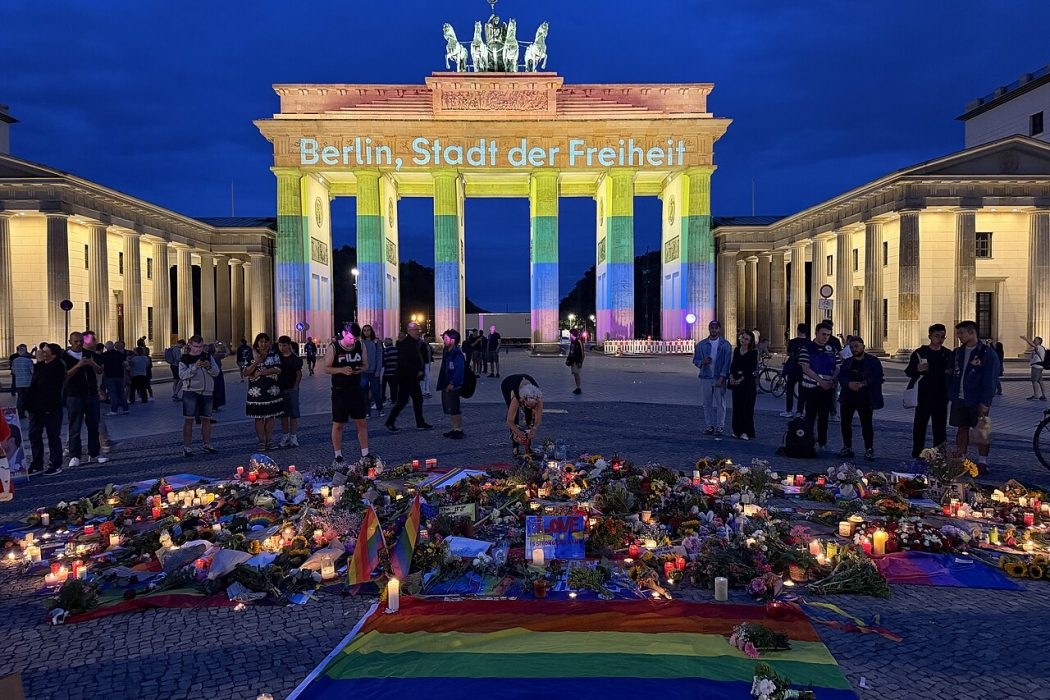
The attack has sent shockwaves through Berlin’s LGBTQ+ community and prompted vigils and memorials near the scene.
Andre Lehmann, a senior official with Germany’s national LGBTQ+ association LSVD+, said in a statement, “We are simply stunned by what happened.”
He added, “This suspected attack hits the heart of the queer community.”
Thousands of people gathered at the Brandenburg Gate on Sunday to pay their respects, leaving flowers, candles and rainbow flags in memory of the woman who died. Other mourners held placards emblazoned with slogans like “Hatred kills,” as people around them cried and embraced.
German Chancellor Friedrich Merz and Berlin Mayor Kai Wegner condemned the violence and reaffirmed their commitment to protecting freedom and democratic values. The incident has also prompted renewed discussion about security at major public events and the threat posed by Islamist extremism in Germany. “We will defend the freedom, openness, and liberal spirit of our lives and our society with everything we can do,” said Merz in a statement ahead of a memorial service at St. Mary’s Church (Marienkirche).
The attack has also renewed debate in Germany over Islamist extremism, security at major public gatherings, and the protection of LGBTQ+ events. German authorities have indicated that security measures for upcoming Pride celebrations and other large public events may be reassessed in response to the attack. Read here and here for more information on this story.